Why a mala has 108 beads
From the New Year bells of Kyoto to the Buddhist canon, 108 has many explanations and no single right one. Then the bead you never cross.

In Kyoto, on the last night of the year, seventeen monks at Chion-in temple haul together on the ropes of a great wooden beam and swing it into a bronze bell more than three metres tall. They shout ‘Ee hitotsu’, ‘one more’, and ‘Sōre’, ‘now’, and the sound rolls out into the dark. They do it 108 times. At many temples across Japan that night, the bells ring the same number of strokes. It is called Joya no Kane, and in Buddhist tradition each stroke clears away one of the 108 bonnō, the worldly desires that bind us. If you practise with a mala, you already know that number: it is the count of beads that pass through your fingers.
One number, many reasons
Why 108? The traditions offer many answers, and none of them is ‘the right one’. They are worth knowing all the same, the way you might know several paths up the same mountain.
The Pali canon of Buddhism contains a short discourse whose title is simply Aṭṭhasata, ‘The Hundred and Eight’. It counts feelings: joy, sorrow and equanimity, arising through each of the six senses, and each tied either to household life or to renunciation. That makes 36. Thirty-six of the past, thirty-six of the present, thirty-six of the future: 108.
In India, the Muktikā Upaniṣad, framed as a dialogue between Rama and Hanuman, lists 108 Upanishads. In Indian astrology the circle of the sky is divided into 27 nakṣatra, the lunar mansions, and each of those into four quarters: 108 steps in all. And devotees often recite the 108 names of a deity, in litanies that carry the number in their title, aṣṭottaraśata, ‘a hundred and eight’.
The coincidence in the sky
You will often read that the distance from the Earth to the Sun is 108 times the Sun’s diameter, and that the same holds for the Moon. It is true, but only on average and with some generosity. Using NASA’s figures, the Sun is about 107.5 solar diameters away, ranging from 105.7 to 109.3 over the year. The Moon is about 110.6 lunar diameters away, swinging between 104.6 and 116.7, because over each month it moves closer and further by tens of thousands of kilometres. It is a lovely coincidence, noticed in modern times with modern measurements. It is not where the number comes from.
There are many reasons for 108. There is only one round of beads, and you are the one who makes it.
The bead you never cross
Mālā is Sanskrit for ‘garland’, and japa is the repetition of a mantra that the beads help you count. Beyond the 108, every mala has one more bead, often larger, with the tassel hanging from it. This is the guru bead, or sumeru, named after Mount Meru, which stands at the centre of the world in Indian cosmologies. It is not counted and it is not crossed. You start from the bead beside it, and when your thumb comes back to the guru, you turn the mala round and continue the other way: the bead that closed your first round opens the second. The reason most often given is respect: this is the teacher’s bead, and you do not step over your teacher.
Shorter malas keep to the same number, often with 54 or 27 beads, a half or a quarter of the round.
Did you know
The English word ‘bead’ comes from Old English gebed, ‘prayer’. In the Middle Ages, as people counted their prayers on the beads of a rosary, the word slid from the prayer itself to the object used to count it.
Japa, finger by finger
- Choose your mantra before you sit. A single syllable such as Om, or the mantra of your own tradition, the same one for the whole round. You can say it aloud, whisper it or repeat it silently.
- Take the mala in your right hand and let it hang over your middle finger, or your ring finger, as some schools teach. The index finger stays out of it: a Sanskrit verse often quoted asks that the mala never be touched with the index or little finger, and many teachers explain that the index finger stands for the ego.
- Begin at the bead beside the guru. With each mantra, your thumb draws one bead towards you and slips it past your finger.
- When you reach the guru, pause. Don’t cross it: for another round, turn the mala and set off the other way.
- At the end, stay seated for a few breaths, the mala resting in your palm, before you put it away.
In Tibetan Buddhism, by contrast, the mala is usually held in the left hand. The rules vary from school to school: if you have a teacher, follow theirs.
An intention on the first bead
Before you begin, close the mala between your palms at your heart. Set your sankalpa, the intention for this round, in one short, plain sentence. Then rest your thumb on the first bead after the guru and let the mantra carry you forward. When your mind wanders, don’t start again from the top: come back to the bead you are on.
Care
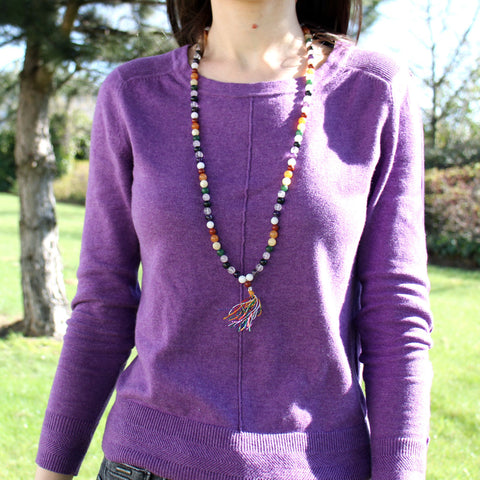
The weak point of any mala is its thread. Check it now and then near the guru bead and under the tassel, where it works hardest: when it starts to fray, restring it before it breaks. If there is a knot between each bead, the beads won’t scatter even when the thread gives way.
Stones dislike perfume, lotion, chlorine and sea water: wipe them with a soft cloth. Some, amethyst among them, fade after months in full sun. Rudraksha seeds and wooden beads, such as sandalwood or tulsi, should be kept dry: if they get wet, dry them straight away. Over time they take on the colour of your hands, the mark of a mala that is used.
If the tassel gets tangled, comb it through with your fingers, hold it for a few seconds over the steam from a kettle, at a safe distance so you don’t scald yourself, and trim it with scissors. Between rounds, keep the mala in a cloth pouch; many people always keep it off the floor.
Try it at home

Sources
- Chion-in temple, Kyoto, official page on Joya no Kane; Wikipedia, ‘Joya no Kane’.
- Aṭṭhasata Sutta, Saṃyutta Nikāya 36.22, translated by Thanissaro Bhikkhu (Access to Insight).
- Muktikā Upaniṣad, vv. 30–39, in P. Deussen, Sixty Upanishads of the Veda; Wikipedia, ‘Nakshatra’, citing the Encyclopædia Britannica.
- NASA, Sun Fact Sheet and Moon Fact Sheet.
- V. S. Apte, The Practical Sanskrit Dictionary; Wikipedia, ‘Japamala’ (J. Kieschnick, The Impact of Buddhism on Chinese Material Culture, 2003; G. Tanabe, ‘Telling Beads’, 2012).
- Smṛtyarthasāgara, verse on the fingers used in japa, quoted by Madhwa Sakha; Swami Sivananda, A Message to New Initiates; New World Encyclopedia, ‘Japa Mala’.
- Online Etymology Dictionary, ‘bead’; Catholic Encyclopedia.